
Stack-Ups: One missed tolerance analysis can add weeks of delay and thousands in rework.
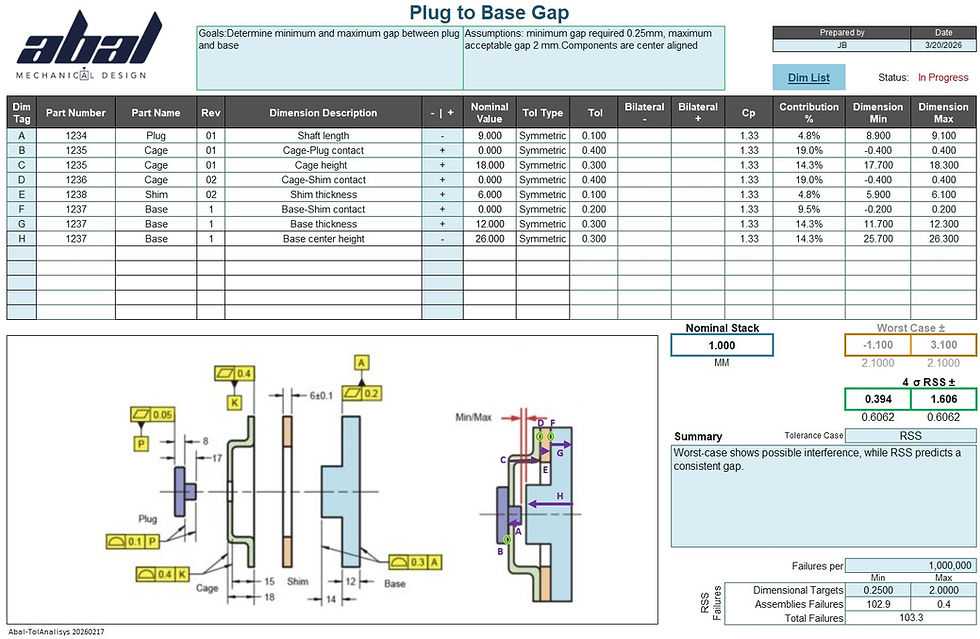
They are not optional. Every critical interface in a mechanical assembly needs one, and it must be based on reliable, up-to-date CAD models and drawings.
Here’s a simple 5-step approach we use to perform professional tolerance studies before releasing an assembly:
1. Define the Functional Goal
Is the objective a specific gap, a press-fit interference, or critical alignment? Write it down before picking dimensions. A clear goal prevents “dimension creep,” where features are analyzed without impacting the final fit.
2. Map the Functional Loop
Keep it simple. Map only the contributors that open or close the functional gap. In a 1D stack, track the chain of dimensions through the assembly to ensure cumulative variation stays within limits.
3. Match the Math to the Risk
Worst-Case: For safety-critical interfaces where failure is not an option.
RSS (Root Sum Squared): Assumes independent variables and normal distribution, suitable for most routine fits.
Statistical Tolerance Analysis: Use statistical methods (RSS) to allocate tolerances more efficiently, avoiding unnecessary tightening while still meeting functional requirements.
4. Assign a Tolerance Budget
Start with the total allowable variation and distribute it across contributors. Tighten where function demands it, relax where manufacturing benefits.
5. Feed Reality Back into the Loop
Measure early builds and feed real data back into the model. Adjust where theory and reality differ. A short check early can prevent weeks of rework later.
In practice, worst-case analysis can predict interference while RSS suggests everything is fine. That gap between methods is where real-world issues show up. Understanding the difference early can save both money and schedule, preventing surprises in the first build.



Comments