
DFMEA should be a design decision tool, not a paperwork exercise.
- May 11
- 2 min read
Updated: May 26
Too often, teams fill it out quickly after the design is already done, just because the process requires it.
But DFMEA is not just a document for audits or program reviews.A strong mechanical engineer uses it to improve the design and reduce risk early.
For mechanical engineers, the best DFMEA discussions are not abstract.They are tied to real design decisions.
At its core, DFMEA is a structured way to think through how a design could fail, what could cause it, how serious the effect would be, how likely it is to occur, how likely the team is to detect it, and what actions are needed to reduce the risk.
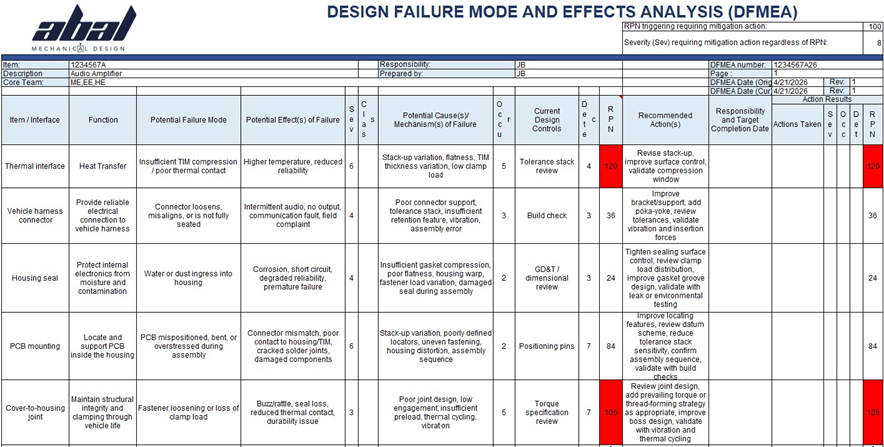
A simple example is a thermal interface.
A housing and a heat-generating component may look fine in CAD, and the TIM may appear to close the gap on paper.
But DFMEA forces the team to ask better questions:
What is the failure mode?Insufficient TIM compression.
What is the effect?Higher component temperatures, reduced reliability, or even component failure.
What could cause it?TIM thickness variation, stack-up variation, poor surface flatness, or insufficient clamp load.
How do we assess the risk?Severity, occurrence, and detection.
What should we change?Maybe tighten surface control, revise the stack-up, adjust the gap or TIM thickness, improve clamp load, or strengthen validation.
That is why DFMEA matters.
Not because it fills a spreadsheet.Because it forces engineers to think through failure before failure becomes expensive.
The most useful DFMEA is not the one with the most rows. It is the one that changes the design, improves the validation plan, and reduces risk early.
If your team needs support with production-ready mechanical design, packaging, or interface-driven components, that is exactly the kind of work we help with at ABAL Mechanical Design.


Comments